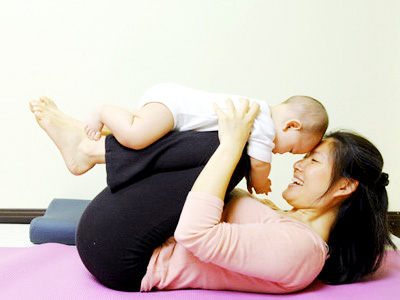
Get Fit With Baby

Photo Credit: Yihungkuo CC-BY-3.0 2009

Women who have had a baby can use exercise time as a time to bond with their baby and enjoy some fun time together. The exercises are a game to baby and fun for you while you firm and tone your body. Exercise also lowers your stress levels, which is important for new mothers. See your doctor before beginning any exercise program or resuming your previous routine. Women who have had a C-Section should not begin or resume an exercise program without their doctor’s okay. Make sure your baby is safe and always hold her securely. Never use dumbbells or other weights when baby is nearby. Don’t push yourself when exercising with baby. The idea is to have fun while getting some light exercise. When your baby can hold his head up on his own, sit up and roll over, you should be able to begin some exercises, but always check with your baby’s pediatrician before beginning exercise games.

Lie down on your back on a soft rug of exercise mat. Bend your knees up toward your chest with your feet together. Place baby on your shins and slowly raise and lower your shins a few inches on her tummy with baby facing you. Raise and lower your shins a few inches, slowly and pretend baby is flying. Hold your baby securely at all times. Repeat this exercise for 2 to 3 minutes. From this same position, you can do some crunches with baby. Keep baby securely on your shins and lift your shoulders using your abdominal muscles. As you perform the crunch, give baby a kiss and then lower your shoulders back to the floor. Perform 10 or more crunches and get lots of kisses.

Lie on your back on the floor and place your baby on your tummy facing you. Hold baby securely. Flatten your shoulders and bend your knees to place your feet flat on the floor. Lift your bottom off the the floor to perform a bridge exercise. Lower your bottom back to the floor and repeat. Baby will enjoy the up and down motion. Do 5 to 10 bridges. From this position, you can move to baby bench presses. Hold your baby firmly with both hands. Bring her close to your chest with your elbows bent and close to your sides. Lift baby straight up above your chest and then lower her back to your chest. Give baby a snuggle or a kiss when you bring him back down.

Morning Exercise to Energize Your Day

Photo Credit: Pedro Simões CC-BY-2.0 2009


We’ve all had days when we didn’t want to get out of bed. To energize your body for the day ahead, try doing some Pilates or other exercises right in your bed. Stretching exercises in your bed before you go down for your morning coffee and breakfast can jump-start your metabolism. A morning workout in your bed can help you have more energy for your regular workout routine later in the day. Your mind and body will be prepared to take on whatever challenges come your way throughout the day. Throw back the covers and exercise!
After hours of sleeping, your back may feel a bit stiff. Roll your body into a ball to stretch out  your spine and work your abs. Sit up in bed and bring your knees to your chest. Hold your knees with your hands and then curve your back by bending forward over your knees. Roll back on the bed on your back and then roll to the upright position again. Perform this exercise for 10 repetitions.
Strengthen and energize your core muscles by doing some leg lifts next. Stretch out on your bed with your legs extended and your arms relaxed by your side. Point your toes toward the ceiling. Lift your left heel off the bed about 12 inches. Lower your left leg until your heel is about 1 inch from the bed. Hold your leg off the bed for about 10 seconds and then raise your leg back up. Repeat 10 times for each leg.
Bring your knees up to your chest and point your toes. Lift your head and shoulders off the bed using only your abdominal muscles. Hold this position for about 10 to 15 seconds and then relax. Repeat this exercise 10 times. Stretch your abdominal and back muscles next by bending your knees so that your lower legs are parallel to the bed. Keep your feet and knees together and your shoulders flat against the bed. Swing both knees to the right side of the bed. Try to keep your shoulders on the bed. Hold for 10 seconds and then swing your legs to the left side. Do 10 repetitions for each side.

How Interval Training Can Improve Your Fitness

Photo Credit: Mike Baird CC-BY-2.0 2007
If you have reached a fitness plateau with your regular workout routine and you would like to get more from each workout, begin interval training. Interval training is alternating light intensity exercise with high intensity exercise. For example, if you regularly walk 30 minutes or more every other day, try walking for 10 minutes followed by 5 minutes of jogging or running and then 10 minutes of walking. Stretching and isometric exercises can be followed by a short burst of high intensity strength training like weight lifting. You can vary your exercise routine in any way that is comfortable for you. You may want to start off by including 20 to 30 seconds of high intensity exercises followed by 5 minutes of less strenuous activity. Interval training can take your fitness to the next level.
People who exercise using an interval training regime burn more calories than steady low to medium intensity exercise for the same length of time. You will lose weight faster or maintain your ideal weight better by burning  more calories during your regular workout. Interval training also improves cardiovascular health and capacity. Start off slowly and build up your strength over time until you can do equal intervals of low to medium intensity exercise and high intensity exercises. 

Intense exercise alone can cause muscle soreness. When you alternate your regular exercise with short periods of intense exercise, your muscle tissue stores less of the toxins and waste products that can cause you to feel sore. You will also have more energy by following an intense period of exercise with a period to cool down while still exercising your muscles. A personal trainer can help you design an interval training regime to help you meet specific goals, such as increasing your stamina or losing belly fat. Interval training can also be combined with functional training to improve athletic performance or strengthen and tone a specific muscle group. 

Strengthen Your Back

Back pain is a common ailment for many adults. Usually mild back pain, such as an achy feeling or soreness, is caused by overuse of the muscles or muscle injury. Most back pain can be alleviated by staying active, exercising and stretching. More serious pain or numbness may be caused by bone, disk or nerve injury or  another condition that should be treated by a doctor. See your doctor to rule out a serious back injury before you start or continue exercising.

Photo Credit: LocalFitness.com.au
Hand-walk on a stability or exercise ball to strengthen your upper and lower back muscles as well as your arms and shoulders. Use a medium to large exercise ball. Lie across the ball on your stomach and stretch your arms out in front of your body. Place your hands on the floor underneath your shoulders. Make a straight line with your neck and back toward your feet. Tighten your stomach and slowly walk forward on your hands until your feet and legs are lifted off the floor. Continue walking forward until your thighs or knees are resting on the ball. Slowly walk back on your hands until the exercise ball is under your stomach again. Keep your body straight and rigid when hand walking forward and backward. 
Stay on the ball on your stomach and try some exercise ball push-ups. Place your hands on the ball under your shoulders and stretch your legs out straight and hold your lower body up with your toes.. Keep your body rigid and tighten your abdominal muscles. Push your upper body up from the ball, hold the position for 5 seconds and lower your chest back toward the ball. Try to do 10 to 15 push-ups.
Raise and lower your back while resting your weight on your hands and knees to strengthen your back muscles, as well as your biceps and rotator cuff. Begin on your knees and place your hands underneath your shoulders with your fingers pointed forward.  Look at the floor and make a straight line with your body from your head to your buttocks. Pull your shoulders back toward your hips and tighten your abdominal muscles. Breathe out and arch your back upward as far as you can. Keep your palms and knees on the floor. Hold this position for 10 seconds and return to the starting position. Next, lift your hip bones toward the ceiling and arch your back so that your belly is drawn toward the floor. Hold this position for 10 seconds and return to the start position. 

Three Simple Changes for Weight Loss

Photo Credit: Hans Hillewaert CC-BY-SA-3.0 2011

It is difficult to completely overhaul your daily eating habits. If you haven’t started a diet and you aren’t sure where to begin, you are not alone. There is no shortage of fad diets, weight loss pills and so-called miracle powders that promise to melt the weight off. The truth is you have to change the way you eat, some of the foods you eat, and you have to exercise regularly to experience healthy, long-term weight loss. You don’t have to stop eating all the foods you love, but you do have to combine diet and exercise for maximum weight loss and a fit body. There are three simple changes you can make today that can start you on your way to losing weight.

1. Enjoy a bowl of soup before a meal. Broth-based soups are usually low in calories, but big on flavor. Soups like tortilla soup, minestrone or vegetable soup taste delicious and can help fill you up so you eat less. Avoid soups made with heavy creams and canned soups. These soups can be high in fat, sodium and calories. 
2. Choose whole grains over processed flour products. Replace your white bread and crackers with whole grains. Whole grain wheat bread contains fiber and many nutrients your body needs. You will feel more full after eating a whole grain bread than you do when you eat processed white bread. Have a bowl of whole grain oats or buckwheat cereal for breakfast. Whole grains contain the carbohydrates your body needs for energy. 
3. Drink more water. If you normally drink 2 sodas per day, replace one soda with a tall glass of water. Flavor water with fresh lemon or add some frozen fruit, such as blueberries or strawberries, to add natural sugars and flavor your water. Keep your body well hydrated. Your skin will look better and your organs will function more efficiently if your body is properly hydrated. 

Why You Need A Personal Trainer

Photo Credit: LocalFitness.com.au 

Most everyone knows they need to exercise to stay fit, lose weight and feel better. Fitness training can help reduce the risk of disease, strengthen bones and muscles and improve cardiovascular function. Not everyone knows how to get started or how to put together an exercise program to meet their physical needs and fit into their lifestyle. Some people are great at self-motivation, but others may need a little help getting started. Even those who are highly motivated may need some advice about which exercises can help them achieve specific fitness goals. A personal trainer can help you design an exercise program that is safe and effective. Your exercise program will be unique and personal. 
How do you know if you need a personal trainer? If you are working out regularly and not seeing the results you expect or desire, then you need the advice and direction of a personal trainer. Many people make the mistake of focusing on a few repetitive exercises that they think will help them achieve a specific goal. For example, a person who wants to reduce belly fat may do sit-ups and crunches every day and still fail to see results. A personal trainer can help you design an exercise program to help you achieve a specific goal. 
You know you need to get fit or lose weight, but you are not sure how to start. A personal trainer can help you define your personal fitness goals. Beginners should consider a personal trainer to help them create a balanced exercise program that includes basic step-by-step instruction and supervision when exercising. An exercise routine cannot help you achieve your fitness objectives if you perform them incorrectly. You also risk injury if you perform an exercise incorrectly. You and your trainer can work together to determine what you want to achieve, set realistic goals and determine how you can achieve your goals. A personal trainer can help you design an exercise program that takes into account all aspects of your life, such as work, family and recreation. You don’t have sacrifice time with family, ignore your work or give up fun to become fit. Exercise and fitness should be an integral part of your life, and a personal trainer can show you how to find the time to work out and reach your goals. 

How Much Exercise Is Enough?

Photo Credit: Beach Cruiser CC-BY-2.0 2009
According to the Centers for Disease Control and Prevention, adults between the ages of 18 and 64 need a minimum of 150 minutes of moderate aerobic exercise every week. Moderate exercise includes walking and strength training 2 or 3 days each week. Adults who enjoy vigorous exercise like jogging, aerobics and running should get about 75 minutes of this type of exercise every week in addition to a couple of days each week for strength training. You can mix up your exercise by alternating days of strength training with a day of moderate exercise and then a day of vigorous exercise. 
Most people will exercise in 30 minute segments every other day to allow their bodies to rest and repair between exercise exertion. It isn’t necessary that you exercise for a full 30 minutes at once. You can break up your daily 30 minutes of exercise into 10 or 15 minute increments and still enjoy the benefits of exercising. For example, if you walk for 10 minutes, 3 times each day Monday through Friday, you will achieve 150 minutes of moderate exercise for the week. As you grow stronger, fitter and your endurance improves, gradually increase the time you work out until you get at least 300 minutes of moderate exercise weekly. 
Aerobic exercise is important for heart and lung health. Exercises that increases your heart rate and breathing counts as aerobic exercise. A brisk walk, mowing the lawn with a push mower, riding a bicycle or chasing the kids around the yard in a game of tag counts as aerobic exercise. Try to get at least 10 minutes of uninterrupted aerobic exercise at a time. More vigorous exercise includes jogging and running, swimming continuously for 15 to 30 minutes, playing tennis or riding a bicycle up and down hills. 
Regular exercise helps control your weight by burning calories and fat, helps to avoid weight-related illness, improves your mood and helps you feel more energetic. If you haven’t exercised in a long time, or if you have any health problems, get a check up and then get active!

Healthy Heart Exercises

Aerobic exercise can help keep your heart healthy. Aerobic, or cardiovascular, exercise strengthens your lungs, your heart and all of your muscles. When you engage in regular aerobic exercise, you may see a decrease in your blood pressure and a lower heart rate. This means that your heart is functioning more efficiently and with less effort. See your doctor immediately if you experience shortness of breath or chest pains during exercise. 
Photo Credit: Public Domain
Begin your daily exercise routine with some stretches to warm-up your muscles, improve circulation and increase the flexibility of your joints. Warming up can help you to avoid injury. Stretch your muscles for 5 to 10 minutes before every exercise routine. Aerobic exercise is more than the dance-type moves you have seen at the gym and on popular exercise CDs. Aerobic exercise is also walking, jumping, swimming, jogging, running, skiing, dancing, roller skating and ice skating. Swimming is one of the best types of aerobic exercise because it works the whole body, including the heart and lungs, and is very low impact. Try to get about 30 minutes of aerobic exercise 3 or 4 times each week. Don’t forget to cool down after 20 to 30 minutes of aerobic exercise by stretching to relax your muscles, cool your body and allow your heart rate to slow down. 
Swimming is one of the best overall aerobic exercises for your heart and lungs. Water aerobics and swimming are an excellent choice for those with arthritis or joint injury. Beginners and weak swimmers should start with walking in the water and doing some water-squats. Build up your strength and endurance until you can swim continuously for at least 30 minutes. Once you reach the target goal of swimming continuously for 30 minutes, increase your swimming time a few minutes each day until you are swimming for a total of 60 minutes. 

Why Run?

Photo Credit: Joe Mabel CC-BY-SA-3.0-migrated

Running is a high-impact exercise that can be exhausting and can cause injury. So why do people who want to get into shape run? People who run to stay in shape do so for a number of reasons, mostly because the health benefits outweigh the risk of injury. People who like to run to stay in shape burn more calories and work their heart and respiratory system harder than people who walk and jog. A runner can burn about 100 calories for every mile he or she runs. Walking, jogging and biking the same distance burns far fewer calories than running. Running 5 miles per day burns about 500 calories. Running does not require anything more than a safe place to run, comfortable clothes and a good pair of running shoes. 
If you decided to take up running to get into shape and lose weight, keep in mind that the important factor in burning calories and fat is not how fast you run, but how long your exercise. Running for 5 miles at a slower pace has a better overall health benefit in terms of weight loss, muscle strength and increased endurance than trying to set a personal record for the fastest time you can run one mile. Running exercises not only the muscles in your body, but your heart and lungs as well. Running can help lower your blood pressure, improve respiration and increase the flexibility of all of your major muscles. 
Runners often experience what is called “runner’s high” or a sense of euphoria associated with the brain’s release of endorphins when a person engages in intense exercise. The brain releases a chemical called betaendorphin in response to physical exertion. This chemical can cause the runner to experience a feeling similar to happiness and excitement. Balance your daily run with proper nutrition, strength increasing exercises and a balanced social life. 
After an invigorating run, you may not feel like eating. The chemicals released by your muscles and your brain may actually serve to suppress your appetite. It is important to balance exercise, rest and nutrition. Consume a high carbohydrate meal prior to running. Whole grain pasta or whole grain breads can help fulfill your body’s need for energy. Drink a glass of water and eat some fresh fruit and vegetables or drink a natural fruit/vegetable smoothie or juice following exercise. You need to replenish your body with nutrients, such as vitamins and minerals, following an  intense workout. 

Are You Ready for Home Based Boot Camp?

Photo Credit: Exey Panteleev CC-BY-2.0 2011
The cold winter weather can discourage even the most dedicated exercise enthusiasts. Snow, wind and cold rain can prevent you from your daily run or jog around the block. Bad weather is dangerous when it comes to driving or even walking to the gym. Don’t let cold, wet or snowy weather deter  you from exercising. You can continue your current exercise program or start a new exercise program right at home in your own living room. How about trying some boot camp exercises at home? You don’t need equipment and you don’t need to drive to the gym to get all the benefits of a home-based boot camp style exercise program. Start your day with 10 minutes of warm-up exercises. Drink a couple of 8 ounce glasses of water, eat a good breakfast with plenty of protein, whole grains and heart-healthy fats. Next, stretch your body and walk in place to prepare your mind and your body for a really intense home boot-camp style work out. Choose some strength and toning exercises that will work most of your major muscle groups and get moving!
Begin with some push-ups. Push-ups work your entire upper body, including your arms, neck, chest and shoulders. This is a great exercise to help you feel energized and ready to take on the world. Beginners should start with push-ups with the knees on the floor. Position your hands under your shoulders and rest your body weight on your knees and hands. Lower your upper body to within a few inches of the floor and the push straight up until your arms are completely extended. Keep your head and spine aligned in a straight line. When you get stronger, extend your legs and rest the weight of your lower body and legs on your toes. Do at least 20 push-ups each morning and another set of 20 in the evening. 
The bridge exercise will strengthen your abdominal muscles, your hip joints and muscles and your buttocks. Lie on the floor on your back with your knees bent. Place your feet flat on the floor and place your hands, palms down, by your sides. Squeeze your abs and lift your hips as high as possible. Hold the position for 10 seconds and then lower your body back to the floor. Repeat this exercise at least 20 times, if possible. 
One of the most effective exercises for your buttocks and hips is the squat. Beginners should hold on to a sturdy chair when performing squats. Those with more balance can stretch their arms out in front of their body or hold their arms relaxed at their sides. Keep your eyes forward and your spine in a straight line and slowly lower your body to a “seated” position by bending the knees. Hold this position for 5 to 10 seconds and then press upward with your legs until you are standing upright again. Do 20 repetitions each morning and again in the evening.  
Work in some high intensity aerobic exercises by marching in place or performing jumping jacks. Jump as high as you can for 10 minutes and then walk in place for another 10 minutes to cool down. Exercise for 10 minutes and then cool down by walking around or marching in place for 10 more minutes. When your heart rate returns to normal after a vigorous workout, stretch to relax.