Still Trying To Lose Belly Fat? Try An Exercise Ball

Photo Credit:  LocalFitness.com.au
It can be difficult to lose stubborn belly fat. There are no reliable and safe quick fixes. Diet pills won’t burn away belly fat and fad diets are dangerous. To get rid of belly fat, you have to eat a healthy, low-fat diet and exercise. Sometimes even the most dedicated person can reach a plateau in the battle against belly fat and just can’t seem to lose those last couple of inches. Try an exercise ball. An exercise ball, also called a fitness ball, may help you tight up your abdominal muscles and lose those last couple of inches of belly fat. Continue to exercise regularly, eat a nutritious low-fat diet and drink plenty of water. 
Exercise ball crunches can help you burn belly fat because you are not only doing crunches, you have to balance on the ball which works your obliques, hips, thighs and lower leg muscles. To do crunches on an exercise ball, sit on the ball with  your feet planted firmly on the floor. Place your feet about hip-width apart on the floor and sit up straight. Cross your arms over your chest. Inhale and squeeze your abdominal muscles. Slowly lean backwards until you feel the pull in your abdominal muscles. Hold the position for a couple of seconds and then exhale as you slowly return to the upright position. Do 10 repetitions if you are a beginner and slowly increase the number of repetitions by adding 5 repetitions every other day. 
The exercise ball lift is an easy-to-do exercise that will really work your abdominal muscles and burn belly fat. Lie on your back and place the exercise ball between your ankles. Place your hands on either side of your body, palms down for stability. Squeeze the ball with your ankles and inhale. Tighten up your abs and slowly lift the ball using your legs. Lift the ball as high as you can and hold it for 3 to 5 seconds. Exhale and lower the ball back to the floor. Do 10 to 15 repetitions. Add 5 repetitions each week until you can perform 25 to 30 repetitions. Add some extra fat burning power to your ball lift by adding an ab crunch to the lift. Cross your hands over your chest and lift your upper body toward your knees as your lift the ball with your ankles. Hold the crunch and lift for 5 seconds and the roll your upper body back to the floor slowly as you lower your legs. 

Cool Down & Get In Shape With Water Aerobics

Photo Credit: Jorge Royan CC-BY-SA-3.0

Many people enjoy a refreshing swim or just splashing around in a pool on hot summer days. Swimming or just playing in a pool is a good aerobic workout. Water aerobic exercises are a safe alternative to regular aerobic exercise for some people. Those who have joint problems, such as arthritis, are overweight, pregnant and most older people, can benefit from water aerobics. Water aerobic exercises are extremely low impact. The water provides resistance, so just walking back and forth across a swimming pool is a good workout. Gyms and community centers often provide water aerobics classes complete with weights, floats and other exercise equipment, as well as trained fitness experts to help you get the greatest, safest benefit from your workout. 
Some of the benefits of water aerobics include improved endurance. The water resistance forces you to work your muscles without the danger of injury associated with weight bearing or high-impact exercises. Simply walking in the pool or swimming will improve your core strength as you engage your abdominal muscles to move against the resistance of the water. The water supports the weight of your body, which makes water aerobics a good exercise for pregnant women. You will stay cool during your workout, too.
Even though water aerobics is generally safe for most everyone, be sure to take some common sense precautions before beginning a water aerobics fitness program. Be sure to see your doctor for a complete physical checkup and tell your doctor that you want to start water aerobics. Make sure that there is a trained and certified lifeguard on duty at the pool where you will be exercising. Remember to drink plenty of water before and after your workout. Stretch your muscles before entering the pool to prepare for exercise. Be very careful walking around in bare feet on the wet area around the pool. Don’t forget the sunblock if you exercise in an outdoor pool. 

Sensible Snacking

Photo Credit: FotoosVanRobin CC-BY-SA-2.0

Americans really enjoy their snack foods. Vending machines are located just about everywhere and contain sugary drinks, chocolate bars, salty chips and pretzels and candy snacks. Convenience stores and many grocery stores place the candy bars and small bags of chips close to the checkout line or beside the cash register where you will be tempted to make an impulse buy. These snacks can contribute hundreds of empty calories to your diet. According to the USDA snacks can amount to nearly 600 calories per day. Many people will consume a full meal’s worth of calories every day just by snacking. Eating between meals does not have to be a diet disaster. You can eat a healthy, nutritious snack between meals that can help boost your metabolism to aid in weight loss. The key to losing or maintaining your weight and still enjoy between-meal snacks is to snack sensibly.
If you get hungry between meals, you should eat a healthy snack so that you do not over-eat at mealtime.  Snacks that will curb your hunger without adding too many extra calories will contain fiber and protein.   Peanut butter on whole wheat crackers or on a stalk of celery will ease your hunger pangs and provide nutritional protein, carbohydrates and fiber to help you feel full. Raisins, walnuts, almonds, dried cherries and apricots or fresh fruits, such as apple slices, a pear, an orange or a handful of grapes are rich in nutrients, fiber and antioxidants. One-half cup of low-fat yogurt with fresh fruit, like blueberries, raspberries or strawberries, can help you feel less hungry while providing your body with important vitamins and calcium. 
Don’t keep a bowl of chips, pretzels, popcorn or candy on the table in the television room! Mindless snacking can add hundreds of calories to your diet and you won’t even realize how much you have eaten. Replace your high-calories television snacks with healthy alternatives like dried fruits, nuts, granola and fruits. Low-fat cheese and whole wheat crackers is a healthy alternative to popcorn and chips. Cut out the sodas when you snack. Drink a glass of water before your snack to help you feel full between meals. 

Walking Poles

Photo Credit: Anwi CC-BY-2.5-IT

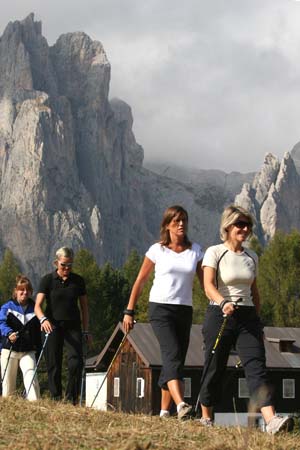
Walking using walking poles, called Nordic walking, is a great way to exercise your arms, shoulders, back and chest muscles during a walk. Nordic walking turns a leisurely walk into a full-body workout. The arm movements when Nordic walking gets your heart pumping for aerobic fat burning. In addition to increasing the intensity of your walk, using walking poles also helps improve your balance and provides points of stability when walking on uneven trails. When you use walking poles, your posture is improved and your back muscles get a good workout while you walk. 
Using walking poles can seem a bit cumbersome at first, but once you get the hang of it, Nordic walking will feel natural. Start out by holding the poles in your hands close to your body with the wrist strap loosely around your wrist. Grip the pole with a relaxed hand so that the poles can swing forward. Allow the poles to swing from your wrist while in your hand. Think about how your arms swing naturally when you walk. When your right foot is forward, your right arm swings toward your back and your left arm swings forward. When your lead foot touches the ground, swing the opposite pole forward and allow it to touch the ground parallel to the heel of your lead foot. As you step forward, push back on the lead pole and simultaneously bring the other pole toward the front in time with your stride. Keep your arms relaxed when walking. The goal is to swing the poles in rhythm with your stride. 

Nutrition Before, During & After Exercise

Photo Credit: Evan-Amos CC0 1.0 PD
Athletes who train every day and the weekend walker and everyone in between needs hydration and nutrition to stay energized and get the most from their workout. Fueling your body before and during a workout can give you that extra edge. Eating the right things after a workout provides the nutrients and trace elements your body needs to repair and recover. Should you eat some of energy bars, chug a sports drink between exercises or can you get all the nutrition and energy you need from a balanced diet? 
Before exercise, the best foods for strength, endurance and energy will contain carbohydrates and protein. Carbohydrates fuel your body and protein is necessary to repair and maintain muscle. Carbohydrates and protein are found in lean meats, whole grain breads, pasta, rice, many fruits and vegetables. A good pre-exercise meal will be low in fat, low in fiber but contain a moderate amount of carbohydrates and protein. Too much fiber will fill you up and make you feel a little sluggish. Drink a large glass of water with your pre-workout meal and drink a second glass of water just before you start to exercise. A sports drink that contains electrolytes and trace nutrients is a good idea if you plan to exercise for 1 hour or longer. 

During your workout it’s a good idea to have a light snack between exercises or during a break in the action if you are playing a sport. Eat a few slices of apple, orange or some grapes to replenish your body’s supply of natural sugars and antioxidants. Refuel your muscles with some carbohydrates available in low-fat cheese slices and whole grain crackers. A handful of granola, some dried fruit or a cup of fruit juice are also good choices to re-energize your body. 

After your workout, you need to replenish the nutrients your body needs to repair and recover. Your muscles need protein to repair and grow, as well as complex carbs to refuel your muscles for the next workout. Lean meats, eggs, whole grain pasta and breads, low-fat dairy  foods, beans and rice are good sources of protein. 
Muscles need protein for recovery and growth, and the best time to deliver protein appears to be right after exercise. Providing high-quality protein after exercise gives your muscles the fuel and the building blocks needed for both repair and for growth. A protein shake can also replenish your body’s store of protein. Remember to drink plenty of water before, during and after exercise to stay hydrated. 

Dump the Saddlebags

Photo Credit: Bill Branson, National Cancer Institute PD
Saddlebags are those pouches of fat that accumulate on the outer thighs. Women are particularly susceptible to fat deposits on the thighs. The best ways to dump the saddlebags are to eat nutritious, low-fat foods and exercise. Cardiovascular exercises, such as swimming, running, brisk walking or jogging and bicycling, help burn fat. There are also some exercises that you can do right at home to help burn away the saddlebags. When you exercise to get rid of hip and thigh fat, you can lose weight overall while building muscle. 
Do some step-ups on a low step stool or a step  aerobics stool. Stand in front of the stool with your arms relaxed at your side. Step up onto the stool leading with your right foot and then bring your left foot up beside your right foot. Step down onto the floor with your right foot and follow with your left. Repeat 10 to 15 times and then switch to leading with your left foot. Add some extra calorie burning to your step-ups by holding a 5 pound dumbbell in each hand. If you don’t have a set of dumbbells, hold a 1/2 gallon container of water in each hand. Use a container with a sturdy handle. 
Side leg raises work the muscles of your thighs, buttocks and abdomen. Hold the back of a sturdy chair and stand up straight. Place your feet about hip-width apart. Drop your shoulders and stretch your spine upward. Lift your right leg upward in front of your body. Keep your leg as straight as you can and then stretch your right leg out to the right of your body. Hold this position for 2 to 3 seconds and then slowly return your leg back to the floor. Do 15 repetitions with each leg. 
Lie on your left side with your left leg on top of your right leg. Rest your left forearm on the floor to support your upper body and place your right hand on the floor in front of your torso. Squeeze your abdominal muscles and lift your right leg straight up toward the ceiling. Keep your upper body straight. Hold your leg up for 5 seconds and return to the start position. Repeat 20 times on each side. 
Squats are great for the abs, hips and thighs. Stand up straight with your feet flat on the floor, about hip-width apart. Place your hands comfortably on your hips. Bend your knees to lower your body to a sitting position. Keep your back straight to avoid bending forward. Push your body back upright using your legs. Repeat this exercise 10 to 15 times. 

Improve Your Push-Ups

Photo Credit: Super Ralf CC-BY-SA-3.0

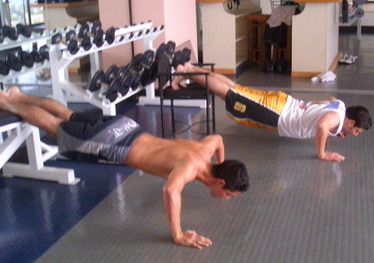
The basic push-up is a great exercise to strengthen the shoulders, arms and back. Military physical tests include push-ups as a measure of fitness and strength. The basic push-up is performed with the body weight supported by the palms and the toes with the body in a stiff, straight line from head to heel. Keep your elbows under your shoulders. Lower your upper chest toward the floor, stopping about 1 to 2 inches from the floor and then push back up from the floor using your arms. Once you are strong enough to perform 75 to 100 push-ups, try some variations to improve the effectiveness of your push-up workout. 
In the start position, place one ankle over the other so that your body weight is resting on the toes of one foot. Perform 50 repetitions and then switch your feet so that your weight is now resting on the toes of the other foot. Repeat 50 more repetitions. 
The torso rotation push-up is a strenuous upper body workout. From the start position for the basic push-up, rotate your upper body to the left as you push up and lift your left arm upward over your head. Your upper body should form a “T” shape so that the front of your body is facing left. Bring your arm back to the floor as you rotate your torso back to the start position. Repeat on the right side.
The plank-style push-up will increase your core strength and stability, as well as workout your arms and chest. Place your forearms on the floor instead of your palms. Hold your body straight for about 10 seconds and then lower your body just a few inches. Push back up and hold for another 10 seconds. 
Elevate your feet on a bench for a powerful push-up workout. Use a low bench or foot stool in the beginning and move up to a regular height bench once you can do 50 to 75 elevated push-ups. Keep your palms under your shoulders for stability.

Benefits of a High-Fiber Diet

Photo Credit: Biswarup Ganguly CC-BY-3.0
Dietary fiber has health benefits from weight-loss, to lower cholesterol and cancer prevention. What’s the truth about dietary fiber? Dietary fiber is found in all plant foots and consists of the parts of the food that your body cannot digest. Many people refer to dietary fiber as roughage. The fiber passes through your body intact because it cannot be digested. There are two types of dietary fiber: soluble and insoluble. Soluble fiber dissolves in water, whereas insoluble fiber does not dissolve in water. 
Insoluble fiber travels through your digestive system relatively unchanged and promotes a healthy digestive system by moving waste through your system. Whole grains, such as wheat, oats, bran, nuts and most vegetables contain insoluble fiber. A diet rich in insoluble fiber can help to regulate bowel movements, which prevents constipation. Eating a diet rich in insoluble dietary fiber can also help prevent hemorrhoids and protect the health of the colon. 
Soluble fiber dissolves in water. Dissolved soluble fiber takes on a gel-like consistency in your digestive system. Soluble fiber can help to lower glucose (sugar) levels in the blood and reduce cholesterol. Soluble fiber also helps to lower the blood pressure. Eat oats, beans, apples, carrots, barley and citrus fruits to get natural sources of soluble fiber. The absorption of sugar from the digestive system into the blood is slowed when soluble fiber is included in the diet. 

High-fiber diets may also help you to lose weight and control your weight. When you eat high-fiber foods, you chew longer and eat less. High-fiber foods help you to feel fuller faster, and you stay full longer than eating foods that are low in fiber. Drink plenty of water and enjoy the benefits of a high-fiber diet. 

Diet Damaging Drinks

Photo Credit: Abhijit Tembhekar CC-BY-2.0

You’ve been watching what you eat, cutting down on calories and getting exercise, but for some reason you just aren’t losing weight fast enough. Have you given much thought to the beverages you enjoy every day? When you are trying to limit calories, don’t overlook the calories hiding in your cup or glass. Fancy coffee drinks, alcohol drinks and even fruit smoothies contain hundreds of diet damaging calories that can interfere with achieving your weight loss goals.
Soda is one of the worst drinks for dieters and anyone who is concerned about watching their weight or controlling the sugar in their diet. The average soda contains several hundred calories and is loaded with sugar. The calories in regular soda are empty calories, meaning you consume hundreds of calories but receive little to no nutritional benefit. Switching to diet soda or sugar-free soda can help, but you may not be able to lose weight by switching to diet soda alone. 
Natural fruit juice contains plenty of vitamins, minerals and antioxidants that your body needs to stay healthy. But, did you know that fruit juice may also contain several hundred calories in just one short glass? Look for fruit juices that are 100 percent juice. Avoid juice drinks or blended fruit-flavored drinks. These types of drinks usually contain 10 percent or less actual fruit juice and contain lots of sugar. Mix  your fruit juice with some cold water to cut down on calories. 
Unless you make your own fruit smoothies, you may be getting little fruit and mostly fruit concentrate, artificial flavors and sugar. Some smoothie shops blend real fruit with sweeteners like ice cream or honey, which can put the calorie count through the roof! Make your own healthy, low-calories, nutrient-rich fruit smoothies at home by blending bananas, strawberries, a splash of 100 percent orange juice or a fresh orange with ice and skim milk. 

Flavored vitamin water is another drink that can sneak in extra calories. Some flavored vitamin water contains sugar. Select flavored water that contains no sugar or make your own flavored water. Refrigerate water until it’s cold. Flavor it naturally with lemon juice or add some sliced strawberries to a glass of cold water for a delicious, refreshing drink. Drink a couple of glasses of water before every meal to help you feel more full to avoid overeating and to stay hydrated. 

Dumbbell Chest Fly Exercise

Chest fly exercises using dumbbells works your chest and shoulder muscles. The anterior and medial deltoids, pectorals, rotator cuffs, biceps and posterior deltoids all get a great workout when you do chest flys on a bench using dumbbells. Proper form is important to avoid injury. A fitness instructor can instruct you in the right way to do dumbbell chest flys to maximize your workout effectiveness and avoid injury. 
Photo Credit: George Stepanek CC-BY-SA-3.0-migrated

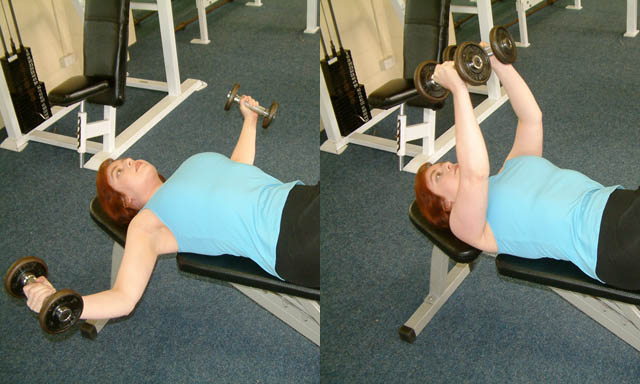
Lie back on a workout bench with your feet flat on the floor. The bench should be high enough so that your thighs and body are parallel to the floor when your knees are bent at a 45 degree angle. If you have never used dumbbells before, start with light-weight dumbbells, between 2 pounds and 5 pounds, and work with a fitness trainer or a spotter. Before you begin doing chest flys, make sure your shoulders are in contact with the bench by pulling your shoulder blades down. The back of your head, your shoulders and your butt should all be in contact with the bench. 
Grasp the dumbbells so that your palms are facing forward, toward the middle of your chest. Raise your arms straight up over your chest with your palms holding the dumbbells facing each other. Keep your wrists stable and your arms straight. Don’t bend your wrists. You should bend your elbows slightly for stability.
Breathe in and simultaneously lower your arms straight out toward the floor. Use a wide arc motion from your shoulder. Lower your arms and the dumbbells until your arms are at your shoulder level parallel to the floor. Hold the position for a few seconds. Breathe out as you slowly lift your arms back toward the ceiling in a wide upward arc motion. 
Do 10 to 15 repetitions of this exercise using the light weights. As your shoulder and arm strength improves, you can increase the dumbbell weight and increase the number of repetitions. Safety is most important when doing dumbbell chest flys. A spotter or certified fitness expert should always be present when you use free weights of any kind.